

AEMEL combines the cost advantages of alkaline electrolysis with the operational flexibility of PEMEL, but limited system lifetime remains the key barrier to commercialization. This article explores AEMEL's technological advantages, key development challenges, and its potential role in the future green hydrogen market.
Anion Exchange Membrane Electrolyzers: Bridging Cost and Performance in Green Hydrogen
Green hydrogen is produced based on electrolyzer technologies via water electrolysis powered by renewable electricity. According to IDTechEx's Green Hydrogen 2027-2037 report, while alkaline water electrolyzers (AEL) and proton exchange membrane electrolyzers (PEMEL) currently dominate the market, anion exchange membrane electrolyzers (AEMEL) are emerging as a promising technology that aims to combine the advantages of both established approaches. However, AEMEL remains at an early commercialization stage, with long-term system lifetime still requiring further improvement before the technology can achieve large-scale deployment.
AEMEL: Combining the advantages of AEL and PEMEL
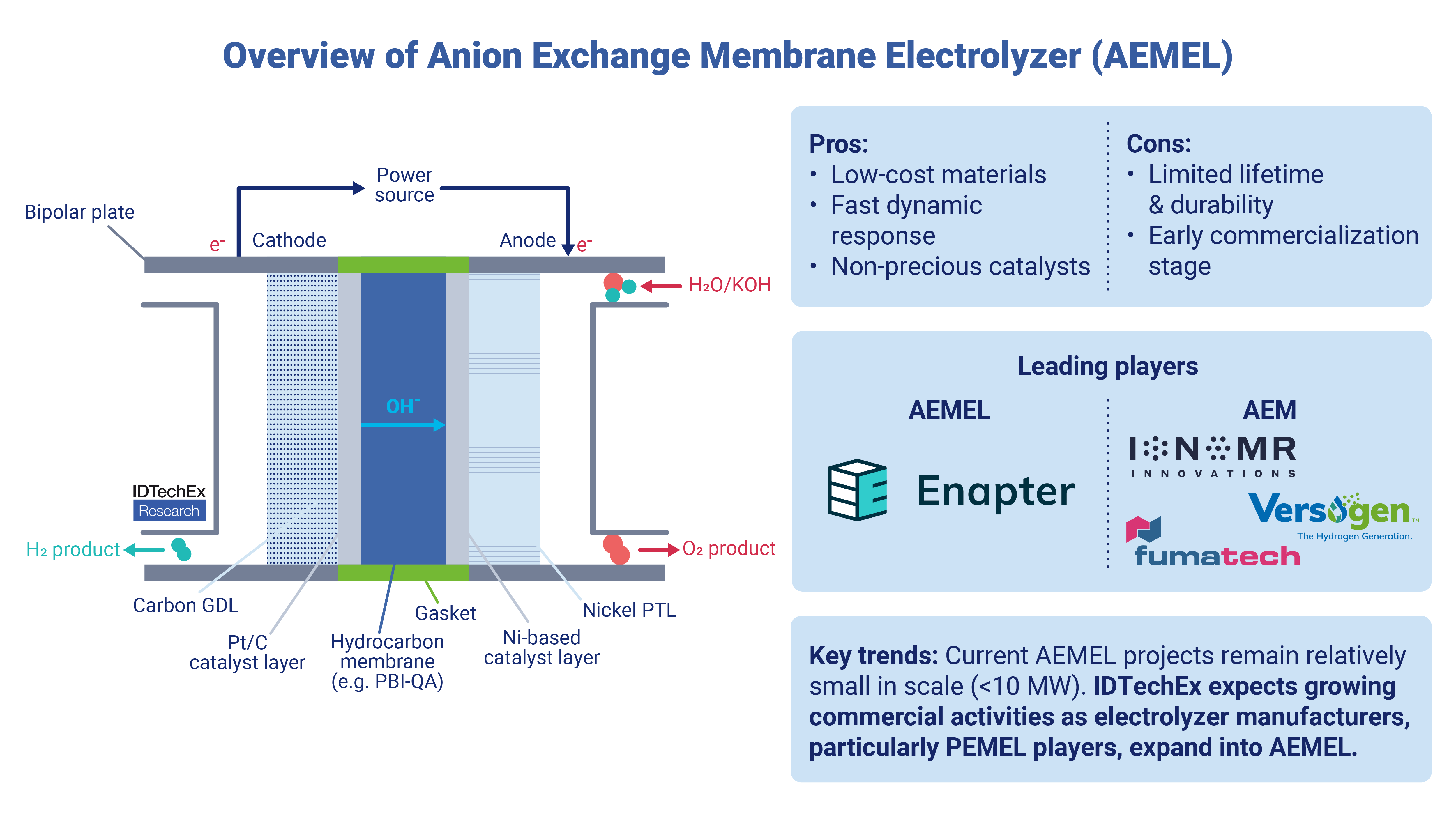
Overview of anion exchange membrane electrolysis (AEMEL) technology, highlighting the cell operating mechanism, advantages, challenges, and leading industry players. Source: IDTechEx.
The primary advantage of AEMEL is its potential to bridge the cost gap and performance between alkaline and PEM electrolyzers.
Similar to AEL, AEMEL utilizes relatively abundant and low-cost materials, including non-precious metal catalysts. Many components used in AEMEL such as electrodes and gas diffusion layers are also derived from existing AEL and PEMEL, potentially benefiting from established supply chains.
At the same time, AEMEL shares key design features with PEMEL. The use of a solid polymer membrane with a zero-gap architecture enables faster dynamic response, allowing the system to ramp up and down more rapidly compared with conventional alkaline electrolyzers. This characteristic is particularly valuable when integrating with renewable energy sources, where electricity supply can fluctuate significantly.
Moreover, the membrane-based architecture helps reduce gas crossover, a key limitation of traditional alkaline systems. Lower gas crossover enables AEMEL systems to operate more effectively at minimal load, improving flexibility during periods of low renewable energy supply.
Limited system lifetime is the largest commercialization challenge
Despite its potential advantages, limited system lifetime remains the primary barrier to AEMEL commercialization. The durability of the anion exchange membrane (AEM) is a major concern, as it needs to maintain high ionic conductivity while operating under alkaline conditions for extended periods. However, prolonged exposure to alkaline environments may accelerate chemical degradation, gradually reducing membrane performance. In addition, water uptake and membrane swelling may compromise mechanical stability, potentially leading to issues such as catalyst layer delamination and declining ionic conductivity. To address these challenges, AEM developers are pursuing different strategies and material innovations. An example is the development of crosslinked polymer backbones designed to suppress swelling and improve mechanical stability.
IDTechEx's report, "Green Hydrogen Production & Electrolyzer Market 2027-2037: Technologies, Players, Forecasts", benchmarks key electrolyzer technologies, including AEL, PEMEL, AEMEL, and SOEC, covering their respective advantages, limitations, stack design and material innovation trends.
Lack of industry standards creates both challenges and opportunities
Due to the relatively early development stage of AEMEL, the technology currently lacks standardized designs and supply chains. At the component level, commercially available AEMs vary significantly in polymer backbone structures and cationic headgroups. These material differences result in huge variation in membrane properties, with each membrane technology involving different balances between conductivity, chemical stability, and mechanical durability. As a result, IDTechEx's interviews with AEMEL developers indicated that companies are currently conducting extensive in-house testing to evaluate membrane performance within their systems, as no widely accepted industry benchmark has been established yet.
Leading companies supplying AEM materials include Fumatech, Ionomr Innovations, and Versogen. IDTechEx also observed that increasing Chinese suppliers such as BriHyNergy are expanding their market presence.
Increasing competition as electrolyzer manufacturers expand into AEMEL
Enapter is currently the leading commercial player of AEMEL. The company has developed standardized modular AEM electrolyzer systems and expanded its global presence through more than 50 international partnerships with local system integrators and joint ventures.
However, competition is expected to intensify as more electrolyzer players, particularly those with PEMEL expertise, enter the AEMEL market. Companies including Schaeffler and Sumitomo Corporation are already showcasing AEMEL systems at recent industry conferences. This trend is particularly visible in China, where IDTechEx has observed a growing number of companies advancing AEMEL solutions. In contrast, European and Japanese electrolyzer manufacturers have generally maintained a stronger focus on established AEL and PEMEL technologies, reflecting a more conservative commercialization approach where extensive validation is often required before market entry.
AEMEL market outlook
Current AEMEL projects remain relatively small in scale, typically below 10 MW. However, IDTechEx believes that ongoing improvements in membrane durability and stack lifetime will enable AEMEL technology to penetrate both traditional alkaline and PEM electrolyzer markets as it matures. Looking ahead, this positions AEMEL as one of the highest-growth electrolyzer technologies within the expanding green hydrogen sector.
IDTechEx's report, "Green Hydrogen Production & Electrolyzer Market 2027-2037: Technologies, Players, Forecasts", provides a comprehensive analysis of major electrolyzer technologies, including AEL, PEMEL, AEMEL, and SOEC. The report evaluates key technology performance characteristics, stack design and materials, and supply chain developments.
For more information on this report, including downloadable sample pages, please visit www.IDTechEx.com/Electrolyzer, or for the full portfolio of related research available from IDTechEx, see www.IDTechEx.com/Research/Energy.
