
The journey towards affordable, large-scale green hydrogen production is linked to the continuous innovation of water electrolyzer stack components. As the heart of the electrolyzer, the stack's efficiency, durability, and cost are directly shaped by the materials and design of its parts. Advancements in these components are therefore critical to driving down the levelized cost of hydrogen. Innovations are occurring across all key areas, including membranes, electrodes, membrane electrode assemblies (MEAs), bipolar plates, and transport layers.
For a comprehensive analysis of this evolving materials landscape, including detailed market forecasts and key industry players, further details can be found in the IDTechEx report, "Materials for Green Hydrogen Production 2026-2036: Technologies, Players, Forecasts". This report covers innovations across Alkaline (AEL), Proton Exchange Membrane (PEMEL), Anion Exchange Membrane (AEMEL), and Solid Oxide (SOEC) electrolyzer technologies.
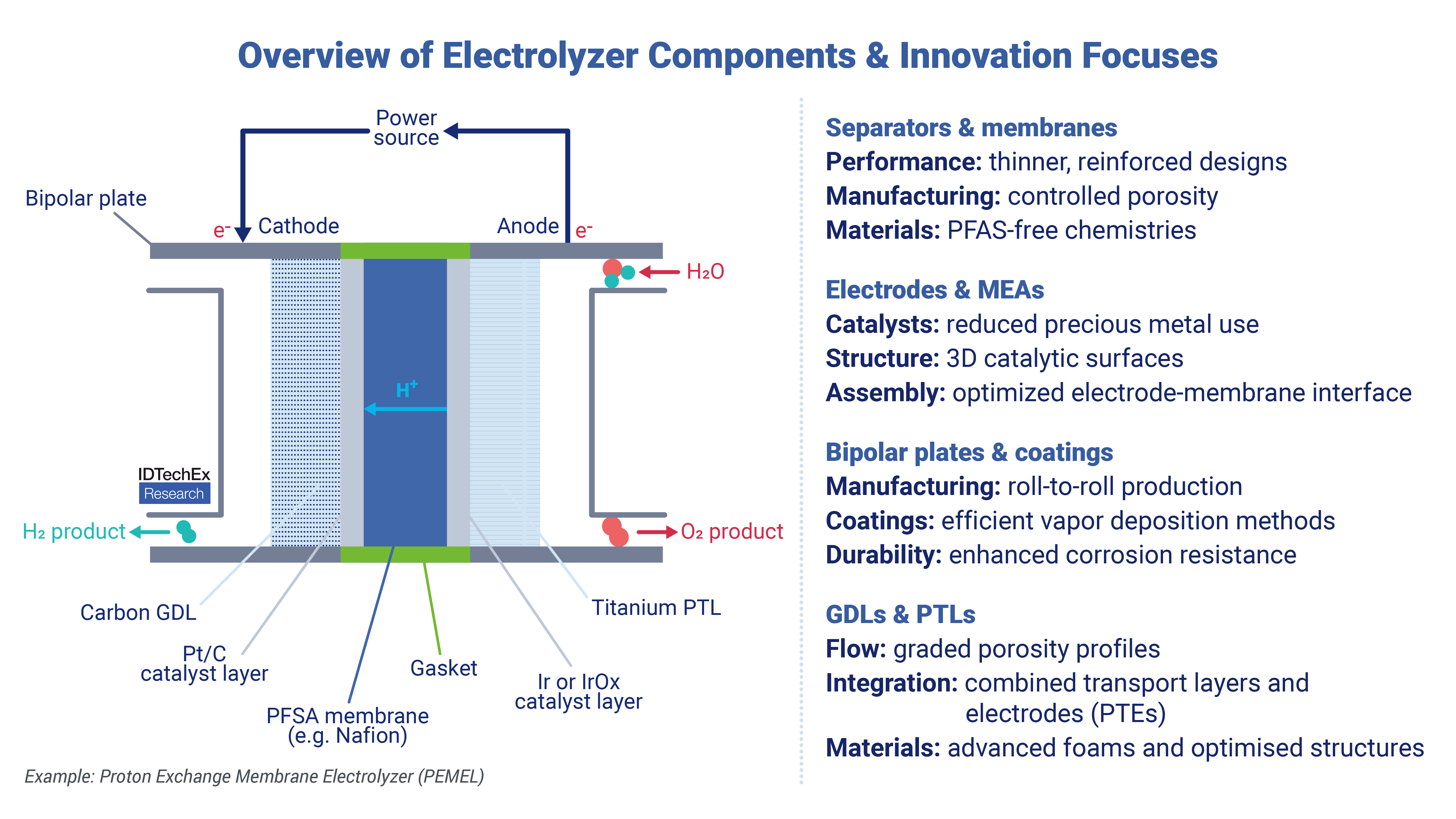
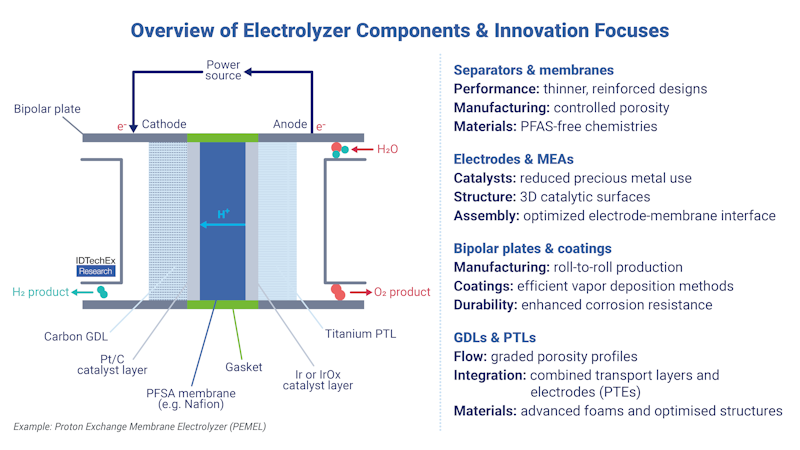
Key innovation focuses for electrolyzer components (PEM electrolyzer shown as an example). Source: IDTechEx
Thinner, stronger separators are key to balancing performance and durability
While the diaphragms in AELs, membranes in PEM and AEM electrolyzers, and electrolytes in SOECs differ in materials and structure, the fundamental innovation goals are similar. Each separator must strike a delicate balance: lowering electrical resistance while maintaining excellent durability and preventing hydrogen gas from crossing over. To achieve this, diaphragms and ion-exchange membranes are becoming thinner, incorporating reinforcement layers and benefiting from improved manufacturing processes that offer greater control over porosity.
Ion-exchange membranes (IEMs) are seeing the most innovation. Serving as proton-exchange membranes (PEMs) or anion-exchange membranes (AEMs), these components are fundamental to PEM and AEM electrolyzers. The PEM market is mature, dominated by established PFSA fluoropolymer manufacturers like Chemours, AGC, and Gore. In contrast, the AEM market is seeing a wave of new players and chemistries emerge. Most AEM manufacturers have developed PFAS-free hydrocarbon membranes, and in response to potential PFAS regulations, PEM manufacturers are now developing similar hydrocarbon-based products. For more information on the IEM market, please refer to IDTechEx's "Ion Exchange Membranes 2025-2035: Technologies, Markets, Forecasts" report.
Advanced electrodes and MEAs aim for higher activity with fewer precious metals
The primary objective for all electrode types is to maximize the active surface area for reactions while using more effective catalysts and minimizing the use of precious metals. For instance, next-generation AEL electrodes are focusing on nickel foams with advanced nickel-based catalytic coatings that create a 3D reaction surface. A key priority for PEM electrolyzers is reducing the amount of iridium needed at the anode through novel catalyst development. For both PEM and SOEC technologies, improving the electrode structure through innovations in membrane electrode assembly (MEA) manufacturing is also a critical focus. The AEM electrolyzer space is less standardized, with OEMs still experimenting with various cell architectures.
Cost reduction is the focus for bipolar plate manufacturing and coatings
Bipolar plate manufacturing has benefited significantly from innovations in the PEM fuel cell industry. Learnings from streamlined, high-precision, automated roll-to-roll production processes are now being transferred to electrolyzer manufacturing, as the fundamental processes are very similar. In addition to conventional stamping and hydroforming, some companies have developed alternative methods, most notably photochemical etching, to further enhance the precision for intricate flow channel designs.
Coatings for bipolar plates represent a major area of innovation, particularly for PEM electrolyzers, which require gold on the cathode side and platinum on the anode side. As conventional plating methods can be wasteful, many companies are now offering advanced vapor deposition techniques to apply these precious metals more efficiently, reducing consumption and cost.
Transport layers with improving flow and stability
Gas diffusion layers (GDLs) and porous transport layers (PTLs) have become essential components in AEL, AEMEL, and PEMEL systems. While AELs have only recently started adopting advanced PTLs like nickel foams, PEM electrolyzers have long relied on carbon paper GDLs and titanium felt PTLs. Key innovation focuses include optimizing mechanical properties for better long-term stability within the stack, creating graded porosity profiles for improved fluid flow, reducing overall thickness, and lowering the need for precious metal coatings on metal PTLs.
Furthermore, AEL and AEMEL electrolyzer OEMs are experimenting with novel porous transport electrode (PTE) concepts, which combine the electrode and the PTL into a single component. This integrated design has already demonstrated increases in stack efficiency, suggesting that future stack designs may increasingly adopt this innovative approach.
Summary & outlook: a multi-billion dollar component market fueled by continuous innovation
IDTechEx projects the annual market for water electrolyzer components to surpass US$10 billion by 2036. This significant growth is driven by the anticipated surge in demand for electrolyzer systems as green hydrogen projects gain momentum and achieve commercial maturity. The electrolyzer sector has a long history of benefiting from continuous innovation, and this trend is set to continue. As this article illustrates, even in relatively mature component areas, there is still substantial room for improvement. For more detailed insights into these innovations, key players, company case studies, and 10-year component market forecasts, please see the full report: "Materials for Green Hydrogen Production 2026-2036: Technologies, Players, Forecasts".
For more information on this report, including downloadable sample pages, please visit www.IDTechEx.com/GreenHydrogen. For the full portfolio of hydrogen-related research available from IDTechEx, see www.IDTechEx.com/Research/Hydrogen.
