

According to the latest Emissions Gap report from the UN Environment Programme, achieving a 42% reduction in global greenhouse gas emissions by 2030 (relative to 2019 levels) is crucial to limiting global warming to 1.5°C. Emerging technologies leveraging metal-organic frameworks (MOFs) for carbon capture, air conditioning and water harvesting, and advanced chemical separation and purification processes could pave the way for disruptive next-generation solutions essential to industrial decarbonization. IDTechEx's latest report, "Metal-Organic Frameworks (MOFs) 2025-2035: Markets, Technologies, and Forecasts", explores the accelerating role of MOFs in this transformation, with demand for MOFs projected to increase 50-fold by 2030.
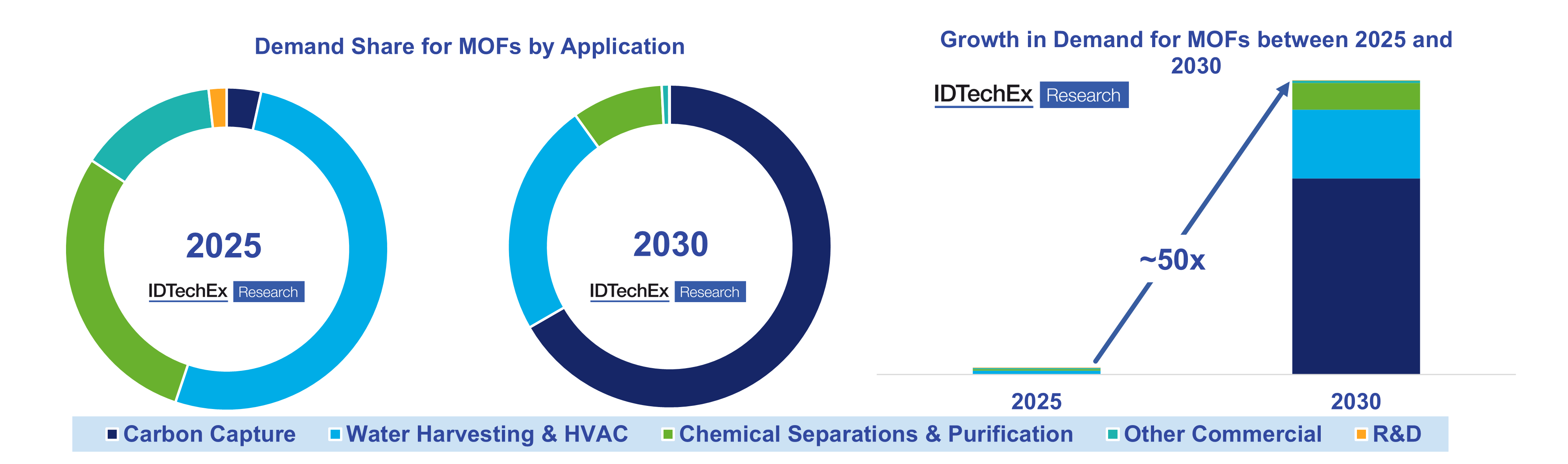
IDTechEx forecasts for the growth in demand for MOFs across different applications. Source: IDTechEx
Advancing Point Source Carbon Capture with MOFs
Deploying carbon capture technologies is crucial for reducing emissions in hard-to-decarbonize industries like cement and steel, supporting low-carbon hydrogen production, and removing CO₂ from the atmosphere. MOFs act as highly selective filters that efficiently adsorb CO₂ in the presence of other gases such as nitrogen and water vapor, with rapid kinetics. However, their main advantage lies in regeneration, wherein saturated filters can be regenerated within minutes using low-grade industrial heat or mature pressure swing processes. These technologies can significantly lower energy costs by 50-80% compared to incumbent methods such as amine scrubbing, positioning MOFs as an attractive, cost-effective alternative.
While MOF-based technologies currently operate at a much smaller scale than conventional amine scrubbing, their modular nature holds promise for rapid expansion. Svante, a leader in this space, launched its new filter manufacturing facility in May, which is capable of producing enough filters to capture 10 million tonnes of CO₂ annually. Other players, including Nuada, UniSieve, and Captivate Technology, are also on the path to advancing MOF-based carbon capture solutions.
A comprehensive analysis of technology advancements, benchmarks, key players, and market outlook, supported by insights from interviews with major players, can be found in the report "Metal-Organic Frameworks (MOFs) 2025-2035: Markets, Technologies, and Forecasts". More information on carbon capture technologies can also be found in IDTechEx's Carbon Capture, Utilization, and Storage (CCUS) Markets 2025-2045: Technologies, Market Forecasts, and Players report.
MOFs: Opportunities to Transform Chemical Separations by Lowering Energy Consumption
Conventional chemical separations and purification processes account for a significant portion of the energy used by the chemical industry. Alternative separation technologies using innovative materials (e.g. MOFs) to replace or supplement existing systems can provide a significant reduction in energy consumption.
For example, propylene, a major chemical feedstock, can be efficiently separated from propane to produce polymer-grade propylene using MOF-based membrane technology. Swiss startup UniSieve told IDTechEx that its molecular sieve membrane technology can reduce energy consumption associated with propylene/propane separation by up to ~90% compared to conventional distillation processes. Additionally, the ability to tune and tailor MOFs to enable selective chemical separation is unlocking applications in direct lithium extraction (DLE), fluorocarbon refrigerant reclamation, biogas upgrading, and more. Detailed analysis of advances in MOF-based technologies for chemical separations is available within the report.
MOFs for Water Harvesting and Energy-Efficient HVAC Solutions
Atmospheric water harvesting (AWH) technologies utilizing advanced sorbents such as MOFs offer a promising solution for water-scarce regions. Additionally, water adsorption and desorption properties of MOFs can also be used for air conditioning and dehumidification systems that can cut electricity consumption by 75% compared to conventional vapor compression refrigeration technologies.
Reducing electricity consumption by air conditioning systems is crucial, as global electricity consumption by air conditioning systems is projected to triple by 2050, driven by increasing needs, particularly in Asia and the Middle East. Additionally, the burgeoning water consumption of data centers, particularly as AI flourishes, is another key opportunity for next-generation water harvesting technologies. Players such as AirJoule are advancing MOF-based solutions, targeting industrial dehumidification and air conditioning, while also seeking market opportunities in data center thermal management, and water production and recapture for the manufacturing industry. Last month, the company announced that it signed a memorandum of understanding with a hyperscale data center developer to collaborate on utilizing AirJoule® for distilled water generation using low-grade waste heat generated by data center operations.
IDTechEx's latest report provides in-depth analysis of material innovations and technology advancements in AWH and air conditioning, featuring performance benchmarks, comparisons with other sorbents, and insights into the key players driving commercialization.
IDTechEx Outlook
MOFs have the potential to drive disruptive next-generation technologies critical for industrial decarbonization. However, foreseeable challenges include the scaling of MOF production economically with strong supply chains, while also demonstrating the scalability and robustness of MOF-based technologies. While early testing and pilot data show promising results, full-scale industrial deployment has yet to be achieved, with commercialization anticipated from 2026-2027 onward.
To accelerate adoption, collaboration between MOF manufacturers and technology developers is essential, ensuring advancements in material performance and process integration. Strategic investments from industrial partners will also be crucial in bridging the gap between pilot success and commercial viability, unlocking the full potential of MOFs in reshaping emissions-intensive industries.
IDTechEx's new report on "Metal-Organic Frameworks (MOFs) 2025-2035: Markets, Technologies, and Forecasts" offers an independent analysis of these trends and considers applications of MOFs for several other early-stage technologies, including hydrogen storage, energy storage, sensors, and more. Informed by insights gained from primary research, the report analyzes key players in the field and provides market forecasts in terms of yearly mass demand and market value segmented by application.
For more information on this report, including downloadable sample pages, please visit www.IDTechEx.com/MOFs. For the full portfolio of decarbonization-related research available from IDTechEx, see www.IDTechEx.com/Research/Energy.
