

In this article, IDTechEx explores how electrochemical technologies could redefine carbon capture as an energy asset.
The climate crisis demands diversity in decarbonization solutions. From CCUS (carbon capture, utilization, and storage) to renewable electricity from wind and solar power, many green technologies must grow in tandem. While the role of electrochemistry is clear for building the hydrogen economy using water electrolysers, IDTechEx's "Carbon Capture, Utilization, and Storage (CCUS) Markets 2026-2036: Technologies, Market Forecasts, and Players" report explores the emerging applications for electrochemistry in carbon capture and utilization.
Fuel cell carbon capture
A fuel cell converts the chemical energy of a fuel directly into electricity. For carbon capture, molten carbonate fuel cells are of particular interest. These cells are powered by natural gas, water, CO2, and O2, but are more efficient than typical gas power generation as no combustion step is needed to generate electricity. Crucially, the CO2 can be a recycled byproduct from the fuel cell or supplied from the flue gas of an industrial process for additional power generation from carbon capture.
At ExxonMobil's Rotterdam Manufacturing Complex, a pilot project using FuelCell Energy's molten carbonate fuel cells is progressing. There is also interest in using this technology for onboard carbon capture in the marine sector. Maritime technology provider Ecospray is working to commercialize molten carbonate fuel cells for ship propulsion, using bio-LNG as a fuel and capturing the resultant CO2.
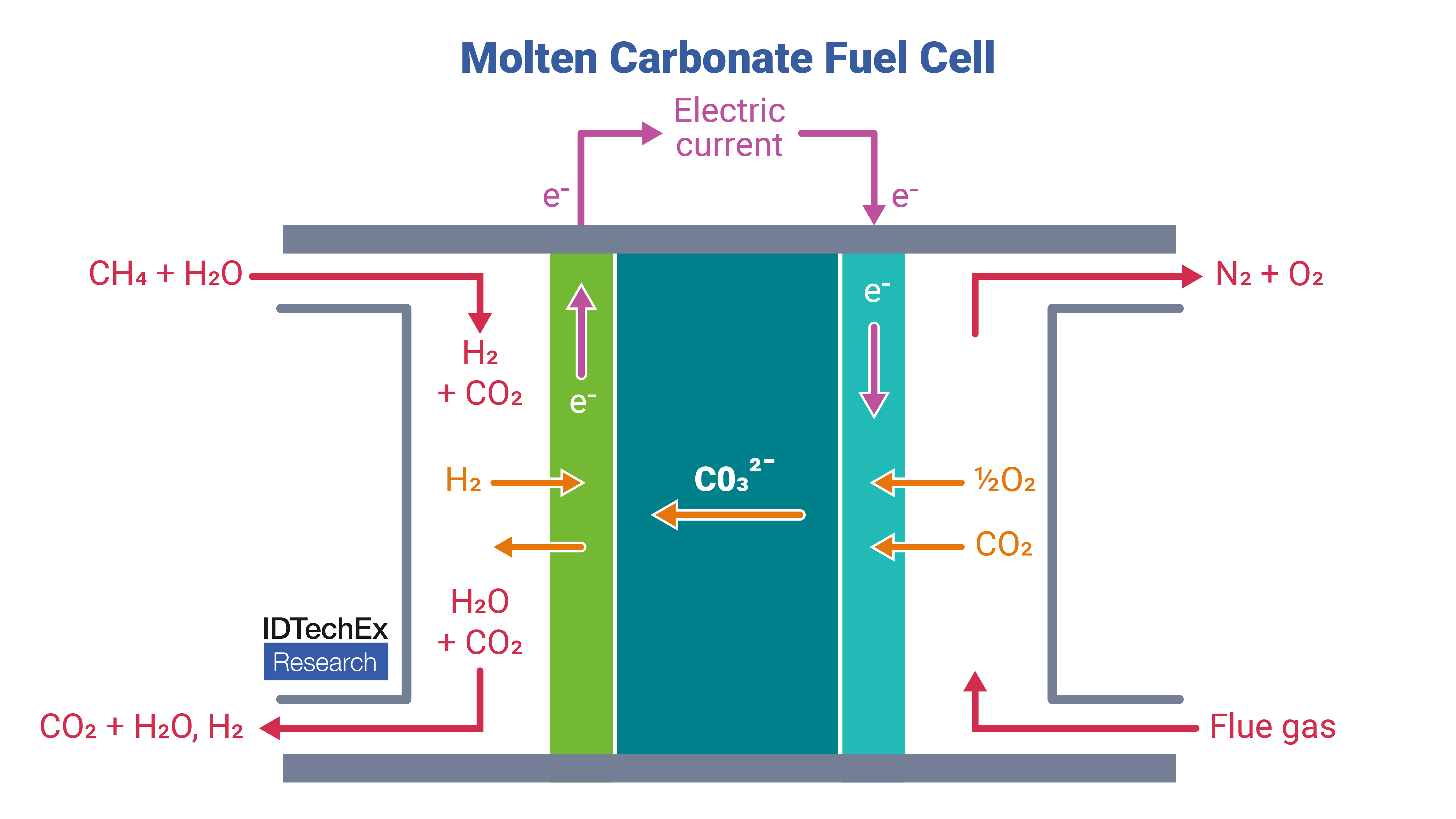
Molten carbonate fuel cell design for carbon capture. Source: IDTechEx
CO2 electrolysis for e-fuels and chemicals
Once carbon dioxide has been captured, it can be valorised to create carbon containing products. The most mature CO2 utilization synthesis pathways for fuels and chemicals are thermocatalytic. However, start-ups are pursing alternative routes based on biological conversion, plasma technologies, photocatalytic pathways, and electrochemical devices.
Co-electrolysis of CO2 and H2O can produce syngas. Longer hydrocarbon e-fuels such as gasoline and kerosene can then be generated using mature thermochemical Fischer-Tropsch synthesis. Electrolysis approaches explored in IDTechEx's "Carbon Dioxide Utilization 2025-2045: Technologies, Market Forecasts, and Players" report include solid oxide electrolyzers and low temperature membrane electrode assemblies.
Electrochemical carbon dioxide removal
Carbon dioxide removal involves extracting legacy CO2 emissions from the atmosphere. It is estimated that gigatonne scale carbon dioxide removal beyond the Earth's natural sinks will be required to reach global net-zero by 2050 goals. Durable engineered approaches include direct air capture (DAC) and direct ocean capture (DOC).
Direct air capture has been on the road to large-scale commercialization for over a decade, with the majority of start-ups focusing on temperature and pressure-based approaches. However, an electrochemical design using electrolysis, electrodialysis, or redox active species could unlock better energy efficiency. Additionally, electrochemical DAC is well-suited to the intermittent nature of low-cost renewable energy sources such as wind and solar. Systems can ramp up quickly when electricity is in high supply and overproduce acid and bases for inherent chemical energy storage. This enables potential secondary applications as a curtailment avoidance tool for renewables.
The same is true for direct ocean capture. While at an earlier stage than DAC, the CO2 levels in the ocean are higher than in the atmosphere, meaning carbon capture from the sea is theoretically easier. Leading players in the space, such as Captura and Equatic, currently have the capacity to remove thousands of tonnes of CO2 per year.
Conclusion
From power generation during carbon capture using molten carbonate fuel cells to avoidance of curtailment for intermittent wind and solar power using DAC, the development of electrochemical technologies could redefine carbon capture as an energy asset. However, the progress of green hydrogen electrolyzers demonstrates that scaling up electrochemical devices has challenges. Widespread deployment for any electrochemical CCUS technologies has not yet been demonstrated at a large scale.
For a comprehensive outlook of the emerging CCUS industry and carbon markets, with an in-depth analysis of the technological, economic, regulatory, and environmental aspects that are set to shape the CCUS industry over the next 10 years, please see the IDTechEx market report on the topic at www.IDTechEx.com/CCUS, or for the full portfolio of energy and decarbonization research available from IDTechEx, see www.IDTechEx.com/Research/Decarbonization.
