

By 2027, two first-of-a-kind SAF plants will be operational in the US. Developments in policy and energy prices will dictate their competitiveness on the domestic market, with the strengths and weaknesses of each pathway being discussed in this article.
US sustainable aviation fuel (SAF) has seen considerable development over the last decade, and IDTechEx has forecasted moderate short-medium term production and market size expectations in its latest report "Sustainable Biofuels & E-Fuels Market 2026-2036: Technologies, Players, Forecasts". Despite his indifference to climate change, President Trump's "Big Beautiful Bill" in July 2025 maintained federal tax credits for renewable diesel (RD). However, the benefit for SAF was significantly reduced. IRC Section 45Z, referred to as the 'Clean Fuel Production Credit', reduced SAF tax credits from US$1.75 per gallon to US$1.00 per gallon, in line with RD. With major clean fuel producers in the US expanding plants and research into the growing field, the bill has led to uncertainty in the US bio and e-fuel markets.
Major Progress in Alcohol to Jet Fuel
Since the 2010s, the primary method of SAF production was via HEFA, a process which processes waste fats into fuels. However, last year the pioneering Alcohol-to-Jet (AtJ) company LanzaJet opened its Freedom Pines plant in November 2025 after investing US$300m. Located in Soperton, Georgia, the facility has the capacity to produce up to 10 million gallons of AtJ SAF per year. No other commercial AtJ production facility exists, making it a first-of-a-kind plant. The plant leverages a unique capability. Changes in configuration enable variations in process output, with SAF:RD ratios shifting between 9:1 to 1:3. In turbulent economic and political times, the plant has the availability to respond to unforeseen tax credit changes and changes in demand from volatile geopolitical climates.
In addition to this, LanzaJet selected Hummingbird®, a process developed by the French engineering company, Technip Energies in 2019. According to Technip Energies, Hummingbird® is a low-cost process for dehydrating ethanol to ethylene (E2E). It operates at lower temperatures and higher pressures, increasing carbon selectivity from ~96% to ~99%. Interestingly, an opportunity also arises to produce niche ethylene derivatives if desired, producing a green pathway for synthesis of other industrial chemicals. By leveraging new technologies, LanzaJet creates an additional competitive advantage.
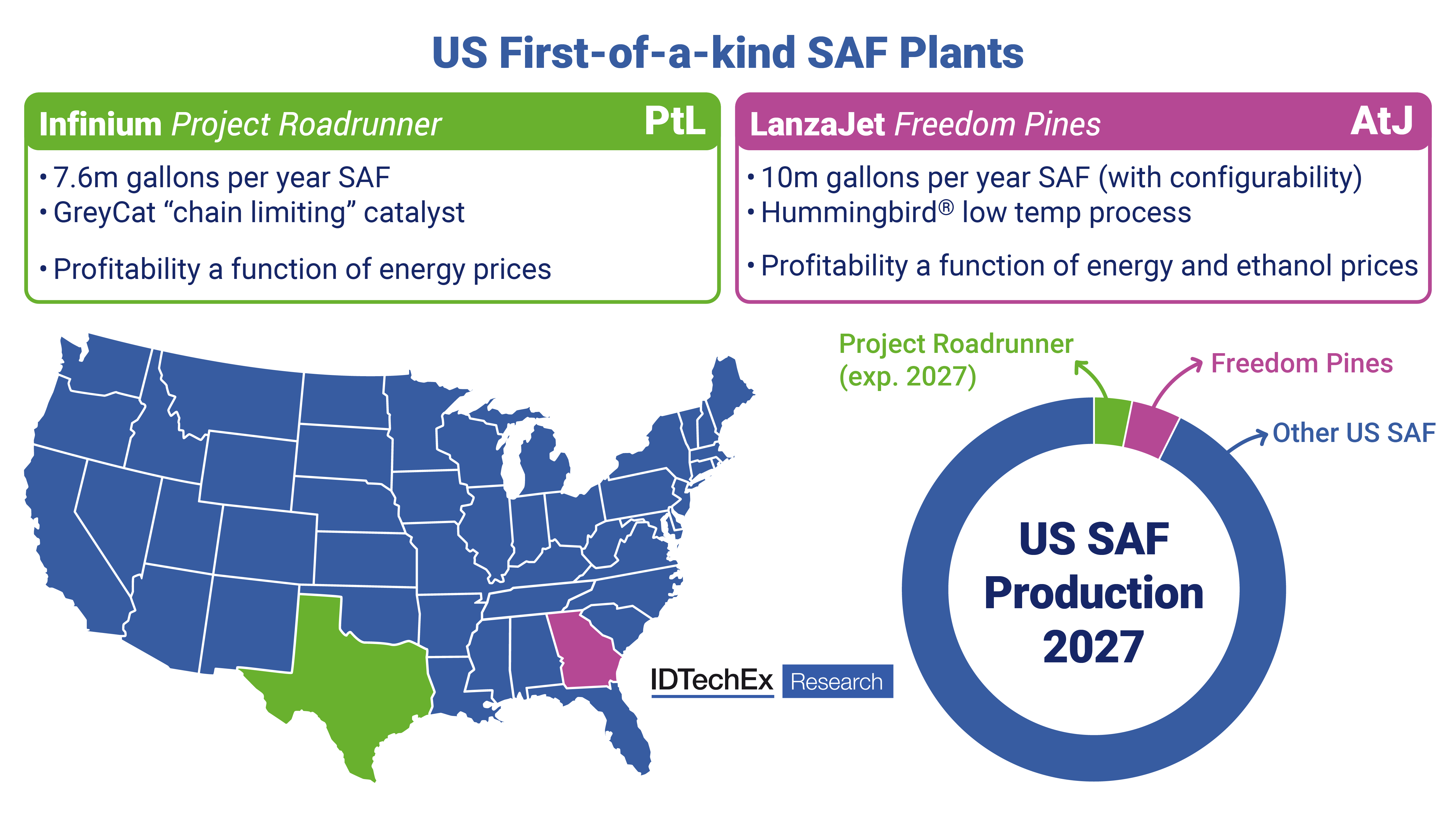
US First-of-a-kind SAF Plants. Source: IDTechEx.
Is Power to Liquid Promising?
A competing project exists in Reeves County, Texas. Developed by the Californian company Infinium, Project Roadrunner seeks to produce e-fuels using an alternative pathway, power-to-liquid (PtL). Compared to using ethanol as a feedstock, PtL uses carbon dioxide and hydrogen to produce a chemically identical fuel to crude oil derived petrochemicals. A major barrier to lowering carbon intensity in PtL plants is the energy demand of producing hydrogen. Hydrogen is used in three main steps of the PtL process: a reverse water gas shift to produce syngas, reaction in the Fisher-Tropsch (FT) reactor, and downstream hydrocracking and hydrotreating. A 150MW wind energy array from HYPRPlant will provide power to produce green hydrogen.
Like LanzaJet, Infinium has also employed novel technology in its process stream. A common byproduct in conventional FT synthesis are long chain waxes which decrease atom economy. In 2025, Infinium acquired Greyrock Technology, developers of a specialised "chain limiting" catalyst called GreyCat. This increases atom economy, reduces downstream separation requirements, and increases profitability of the plant, which is expected to come online in 2027.
Outlook
Both facilities are first-of-a-kind projects developed and operated under Build-Own-Operate (BOO) models, where each plant is built, owned and operated by the company itself. This provides indefinite ownership and attracts long-term investment. Long-term viability of each respective pathway is highly dependent on feedstocks and energy prices.
The U.S. Energy Information Administration reported 141GW of additional grid capacity by 2030, representing an increase of 11% from 2025. However, in Elon Musk's recent interview with Zanny Minton Beddoes, editor-in-chief of the Economist, he stated that the global supply of AI chips is growing faster than the expansion of the power grid. In the next few decades, rapid growth of the US grid may materialise, funded through both public and private interests. Assuming an energy supply increase corresponds with a price decrease, PtL will become much more viable in the e-fuel scene, and Infinium is well positioned to take advantage.
On the other hand, AtJ is highly dependent on ethanol feedstock availability and production. For long-term sustainability and competitiveness, the opportunity cost of growing corn, harvesting, fermentation and AtJ processing may be higher than PtL, lowering its cost competitiveness. Nevertheless, second-generation ethanol produced using waste biomass such as corn stover can provide a low-cost feedstock. LanzaJet, being the first to market, will take advantage of the current high energy prices, stable ethanol prices, 45Z tax credit support, and is positioning itself as a key long-term player in the US SAF market.
US policy support for SAF could increase soon. With US presidential elections just over two years away, support for SAF production facilities could strengthen significantly in the early 2030s. Infinium and LanzaJet's patented catalysts point their futures in strong directions, given that competing companies must undergo lengthy R&D before investing in a full-scale plant. With the industry in its scale-up phase, and 11 ASTM-approved SAF production pathways, the landscape will see significant change. IDTechEx has forecasted its SAF expectations over the next decade in its report, "Sustainable Biofuels & E-Fuels Market 2026-2036: Technologies, Players, Forecasts". It includes a comprehensive analysis of alternative fuel production pathways, key industry players, and SWOT assessments.
For more information on this report, including downloadable sample pages, please visit www.IDTechEx.com/Biofuels, or for the full portfolio of energy and decarbonization-related research available from IDTechEx, see www.IDTechEx.com/Research/Decarbonization.
