

Experts say that the energy in winds miles above the earth is sufficient to provide the world's energy needs. One company working towards harnessing this energy is Kite Gen Research, based in Italy. Kite Gen uses kites or "semi-rigid automatically piloted high efficiency air foils" which harness energy from winds at altitudes of up to a thousand metres. The kites are attached to power generators on the ground by high resistance lines which control the kites' direction and angle to the wind. Kite Gen says their method is faster and more constant than using traditional windmills.
A clear advantage of this technology is visually suggested in the illustration below where the Kite Gen concept is compared with a wind turbine, whose most efficient part are the wing tips in red, where the highest speeds are reached. Using a kite only the essential components remain - the high speed wings and the generator which is moved to ground level. The resulting structure, base foundation included, is much lighter and cheaper. Moreover the operative height can be adjusted according to wind conditions.
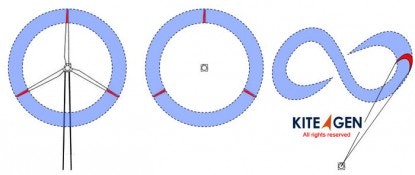
Source: Kite Gen
The KSU (Kite Steering Unit) allows a power kite or an array of power kites to be automatically piloted over a predefined flight path. The power kite is manoeuvred by differentially unrolling and recovering the two lines on two winches controlled by engines. Each Kite Gen power plant is composed of several KSUs and at the core is software that receives data from on-board avionic sensors and autonomously pilots the power kites, so that their flight patterns can be controlled, synchronized and directed to maximise the production of energy.
The Kitegen is a simple aerodynamic system where the kites create lift dynamically by flying at 70-80 m/sec; this is the speed reached by the tips of the blades of a conventional wind turbine. In the simplest configuration (called "stem"), the system uses a single kite linked to a power generator located on the ground. When the kite moves up it generates energy that is transformed into electric power by the generator. When it reaches its maximum height, it is placed in an aerodynamically non-lifting configuration, so that it can be pulled down at a very small energy cost. A single stem could have a maximum power of a few MW. Larger plants could be operated in the "carousel" configuration. In this case, the kites fly at a constant height and at much higher altitudes, pulling a generator that moves on a circular rail. For a large carousel system, the maximum power obtained could be 1 GW or even higher.
Kite Gen is putting this technology to use in a new project called KitVes. The main objective of the KITVES Project is to provide power aboard vessels including supplying energy to on board services and auxiliaries and supplying energy for traction purposes on electric motors-powered vessels.
Credit Kite Gen
Top image of Kite Gen Carousel, source Kite Gen
For more read : Energy Harvesting and Storage for Electronic Devices 2009-2019
