

Ammonia is the world's 2nd most produced chemical, and 80% of it is currently used to produce fertilizers. Ammonia is produced from hydrogen and nitrogen. Conventionally, the hydrogen is sourced from natural gas, tying its production to price volatility and geopolitical supply risks as has been seen at the Straight of Hormuz.
Decoupling ammonia production from natural gas is occurring via green ammonia production, which uses the electrolysis of water as a hydrogen feedstock. When powered by renewable electricity this process is carbon neutral. Furthermore, green ammonia can be used as an energy carrier, further reducing reliance on fossil fuels. When combusted, ammonia produces harmless byproducts: water and nitrogen gas. It can also be cracked into hydrogen, which can then be used in application such as fuel cells. To find out more about ammonia production and its emerging applications, see "Ammonia Market 2026-2036: Technologies, Forecasts, Players".
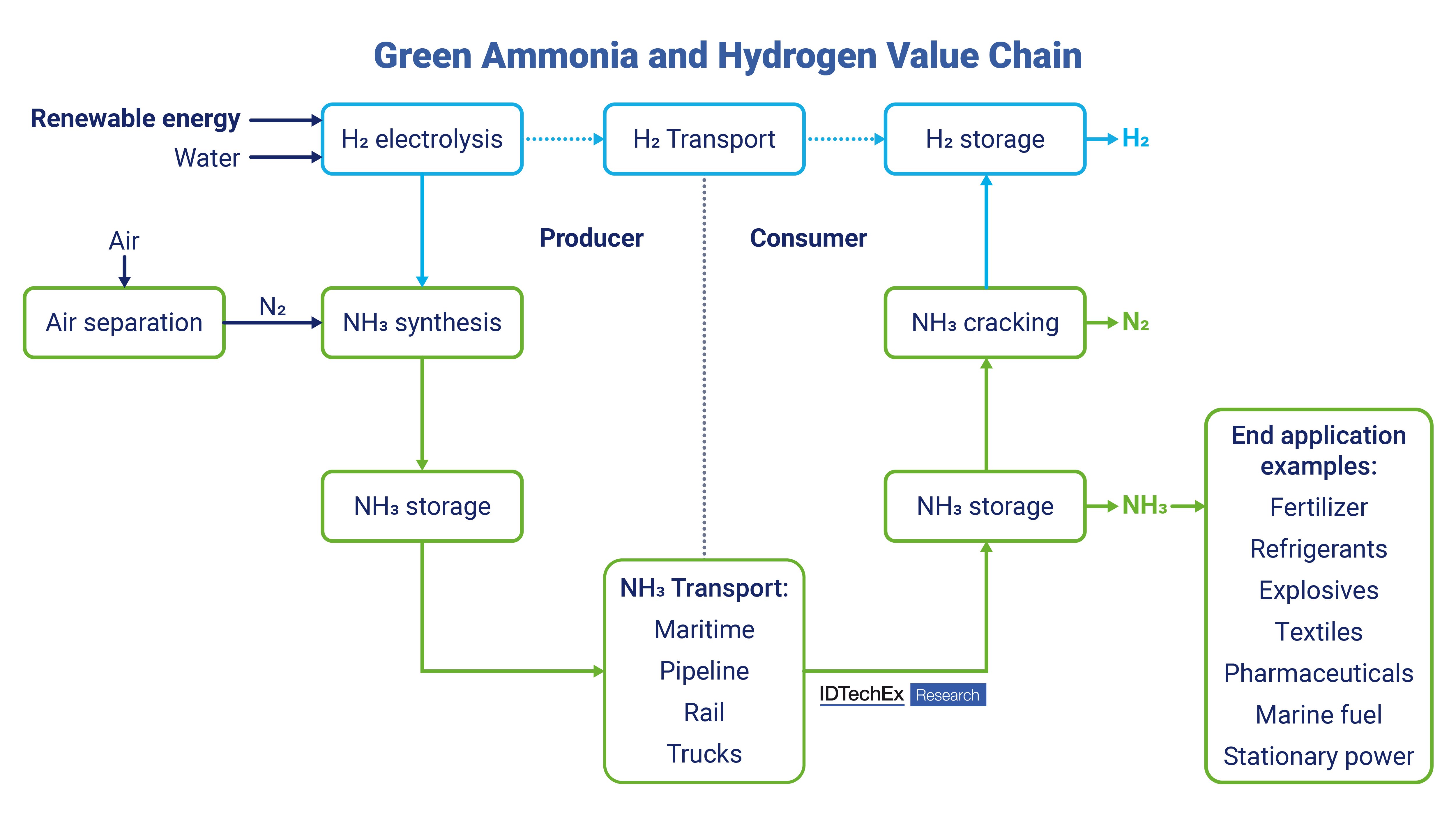
The green ammonia and hydrogen value chain. Source: IDTechEx.
Part of the reason that ammonia is considered a promising potential future green fuel and hydrogen carrier is its existing transportation and distribution infrastructure owing to its global trade which is already at a large scale. Roughly 20 million tonnes of ammonia is transported by marine vessels globally via approximately 200 ports. There are also several thousands of ammonia pipelines in operation globally. Further developments of this infrastructure are planned, for example ammonia bunkering projects in South Korea, India, Singapore and Rotterdam, which enable the use of ammonia as a marine fuel.
China is the current leader in green ammonia production, and it has announced significant developments to its pipeline infrastructure. An approximately 300 km pipeline has been announced to be between Chifeng City and Jinzhou Port in North-East of China. This will transport green ammonia from China's large scale production facility and will be China's first large-scale green energy corridor. Green hydrogen and methanol will also be transported from Chifeng to Jinzhou. This project is expected to start in 2026.
Ammonia is increasingly considered a practical option for transporting hydrogen at scale, offering a way to connect low-cost renewable energy regions with areas of demand. Ammonia can be stored and transported under less extreme conditions than hydrogen with a higher volumetric energy density. Compared to other hydrogen carriers such as toluene, ammonia would require no recycling and dehydrogenation does not result in any carbon emissions.
However, the role of ammonia as a hydrogen carrier presents some challenges. Converting hydrogen to ammonia and back introduces large efficiency losses, and ammonia cracking is an energy-intensive, endothermic process that may need to occur in regions without low-cost renewable energy. In many cases, producing and using hydrogen locally, or directly decarbonizing ammonia production for its established applications such as fertilizer use, could be more efficient than relying on long-distance transport and reconversion.
There have been several commercial demonstrations of ammonia's use as a marine fuel. In June 2025, the AEA said that 64 ammonia fueled vessels have been ordered so far. Ammonia cannot be utilized as a drop-in replacement for marine fuel and has several disadvantages. Its poorer combustibility means it requires pilot fuel, often 5% of the mixture is diesel. It also requires larger fuel injectors and fuel storage as it is less energy dense than many fossil fuels. It faces significant competition from other greener marine fuels. For example, methanol has over 300 ships currently on order and more than 60 are already in use.
Incomplete combustion can result in the production of harmful NOx gases which need to be removed by a catalytic converter. However, this is not widely anticipated to be an issue for ammonia combustion. There is interest in using ammonia for power generation. Vernova and IHI are aiming to achieve commercial deployment by 2030 of a 100% ammonia gas turbine. Ammonia has also been used alongside coal in Japan, with another example in Indonesia. Ammonia has also been investigated for industrial heat applications, with several first ever demonstrations, for example for ceramic tile manufacturing.
IDTechEx's report "Ammonia Market 2026-2036: Technologies, Forecasts, Players"covers the entirety of the ammonia value chain from production, transportation and storage to emerging applications. It also covers trends such as a move towards decentralized local production of ammonia, which avoids ammonia transportation and can bring decarbonized fertilizer to regions with high import costs. For production, it includes insights into emerging alternatives to Haber-Bosch production methods, as well as covering grey, blue and green ammonia production in detail. It also covers the regulatory landscape for ammonia and other drivers for low-carbon ammonia production and use.
For more information on this report, including downloadable sample pages, please visit www.IDTechEx.com/Ammonia, or for the full portfolio of related research available from IDTechEx, see www.IDTechEx.com.
