

In this article, IDTechEx explores the complex regional landscape of the nuclear small modular reactor (SMR) market, and how early deployments from China and Russia's state-owned organizations in deploying SMRs compare to the private nuclear industries of Europe and North America.
In the wake of the newest wave of oil and gas market volatility, as well as the growing power demand from AI data centers, attention has once again turned to nuclear power as a reliable, domestic, low-carbon energy source. Specifically, new interest has gathered around small modular reactors (SMRs), which are roughly 10-20% the size of traditional large nuclear plants in terms of power output, but in return promise better economics for nuclear with faster and more flexible deployment.
With early commercial deployments online in Russia and China, and significant investments and policy shifts being made in the US and Europe in the last few years, IDTechEx forecasts that the total SMR market could reach US$53.8 billion in 2036 and almost US$300 billion by 2046, as detailed in the newest "Nuclear Small Modular Reactors (SMRs) Market 2026-2046: Technologies, Players, Benchmarking, Forecasts" report.
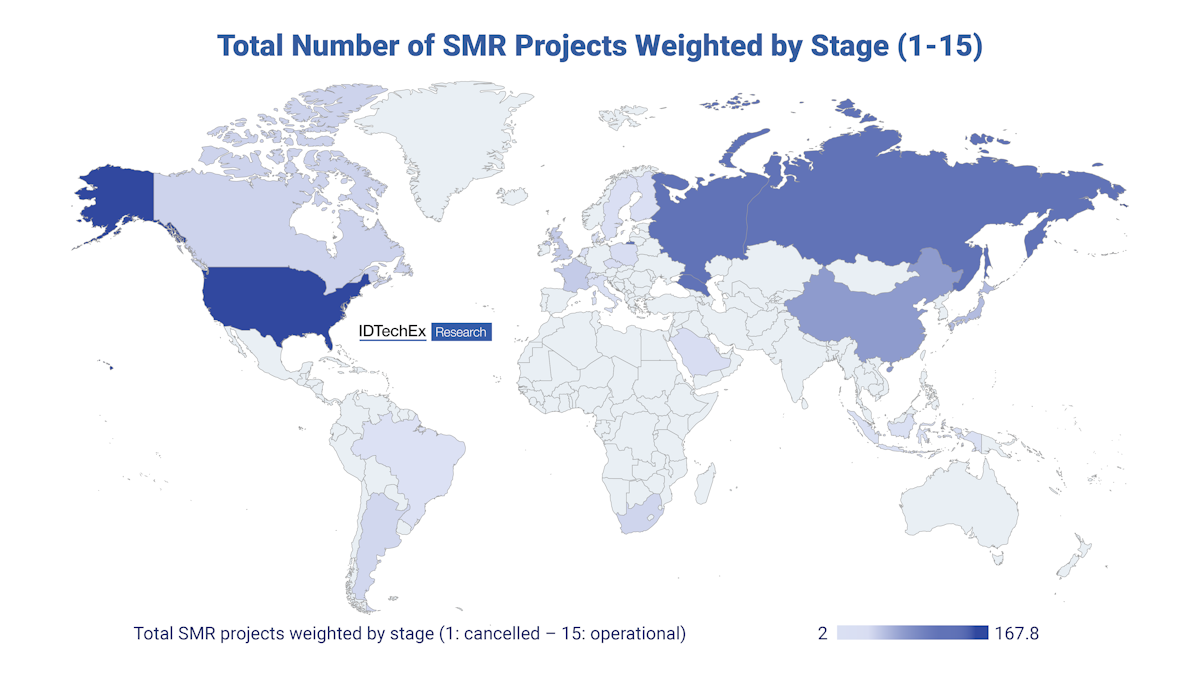
Image source: IDTechEx
SMRs Change the Game for Nuclear
While technology differences exist between different SMR designs, such as the fuel, coolant, or thermodynamic cycle used, the core proposition of SMRs is to make commercial nuclear power more attractive. Traditional "stick built" nuclear power plants are operated as national infrastructure projects, with capital costs typically in the tens of billions of USD, construction taking several years, and cost or time overruns frequent.
SMRs transfer the economy of scale from maximizing the output of a single plant to optimizing the scale production of reactors. Most SMR designs propose that most, if not all, of the reactor's components can be factory-built before being delivered to the site, and by virtue of the project's smaller size, they are less likely to run into delays or cost overruns. There is also a political component, in that making a nuclear project deliverable from start to finish within a 4- to 5-year term minimizes the risk of disruption upon a change of government administration.
Competitive SMR Cost Requires Strong Commitment
The reality, however, is that the first-of-a-kind (FOAK) of any SMR design will still be an expensive investment. Most SMR developers agree that reaching a competitive LCOE requires commitment to production of at least 6-10 units of the same reactor design, which would unlock capital cost reductions of around 40% compared to the FOAK. The evidence for this is in similar learning curves demonstrated by the manufacture of reactors for nuclear submarines.
The solution to overcome this initial cost barrier will most likely come from public funding support, even in economies driven primarily by private capital. The evidence here is that Russia and China have secured early success in the SMR market, with power-producing units already up and running and more projects set to come online soon. In these economies, SMRs are designed and built by well-established and state-owned nuclear power organizations like Rosatom and China National Nuclear Corporation (CNNC). This structure centralizes the funding, construction, and supply chain for new reactors in line with national strategy.
In western economies, public-private partnerships are the most likely route, where private nuclear companies design and deploy SMR projects, but national policy acts as a catalyst and financial backstop for bringing them from concept to reality.
Competition Spurred in North America
Government initiatives and a new surge of private investment into nuclear startups have already pushed SMRs up the agenda in many countries. The US in particular seeks to reclaim its role as a hub for nuclear energy innovation and capability. Since four executive orders were issued in May 2025 to "reform" and "reinvigorate" the US nuclear industry, actions taken include tax credits and US$2 billion federal risk insurance for new nuclear projects, investments into the fuel supply chain, and a new Nuclear Reactor Pilot Program with 11 initial candidates.
The full SMR Market report contains case studies of some of the most prominent SMR startups, such as Oklo, NuScale, Kairos Power and X-Energy, which with the support of government and tech hyperscaler investment are competing to get SMR power deployed in North America. Meanwhile, established nuclear developers like Westinghouse and GE Vernova Hitachi Nuclear Energy (GE-Hitachi) have highlighted the export potential of SMRs, with their modular, factory-built nature making them potentially more suitable for deployment in smaller nations particularly across Europe and the Middle East.
Global Market Outlook
Ultimately, one of the strongest drivers for technology development is competition. Russia and China have shown that consistent policy and a centralized nuclear industry for reactors, components, and nuclear fuel can lead to early successes in SMR deployment.
In 2026, key market drivers such as energy security, decarbonization goals, and demand from data centers have pushed SMRs up the agenda for other governments. However, future success is dependent on whether public-private partnerships can bring not just demonstrator units but fleets of reactors online.
Reflecting on these drivers and challenges, the newest IDTechEx SMR Market report, "Nuclear Small Modular Reactors (SMRs) Market 2026-2046: Technologies, Players, Benchmarking, Forecasts", contains 20-year forecasts for the SMR industry, with granular data split by geographic region and by reactor technology. The report contains case studies of SMR projects across Russia, China, the US, UK, Japan, Korea, and more, as well as a quantitative benchmarking scheme for 10 different reactor technologies based on a database of over 100 SMR projects.
For more information on this report, including downloadable sample pages, please visit www.IDTechEx.com/SMRs, or for the full portfolio of energy-related research available from IDTechEx, see www.IDTechEx.com/Research/Energy.
