

The chemicals sector needs to decarbonize to reach net-zero by 2050 goals globally. In this article, IDTechEx discusses key technology innovations, production scales, and the business case for CO2-derived chemicals, based on the circular economy concept of carbon dioxide utilization.
Petrochemicals underpin the global economy and are found in most manufactured goods. However, the chemicals sector is also a major emitter of carbon dioxide. Green alternatives to fossil fuel feedstocks are a promising solution. Utilizing captured CO2 as the replacement source of carbon found in chemicals, creating a circular economy, is particularly attractive. According to IDTechEx's "Carbon Dioxide Utilization 2026-2036: Technologies, Market Forecasts, and Players" report, production of CO2-derived polymers (a family of chemicals that includes plastics) is forecasted to reach 4 million tonnes per annum by 2036.
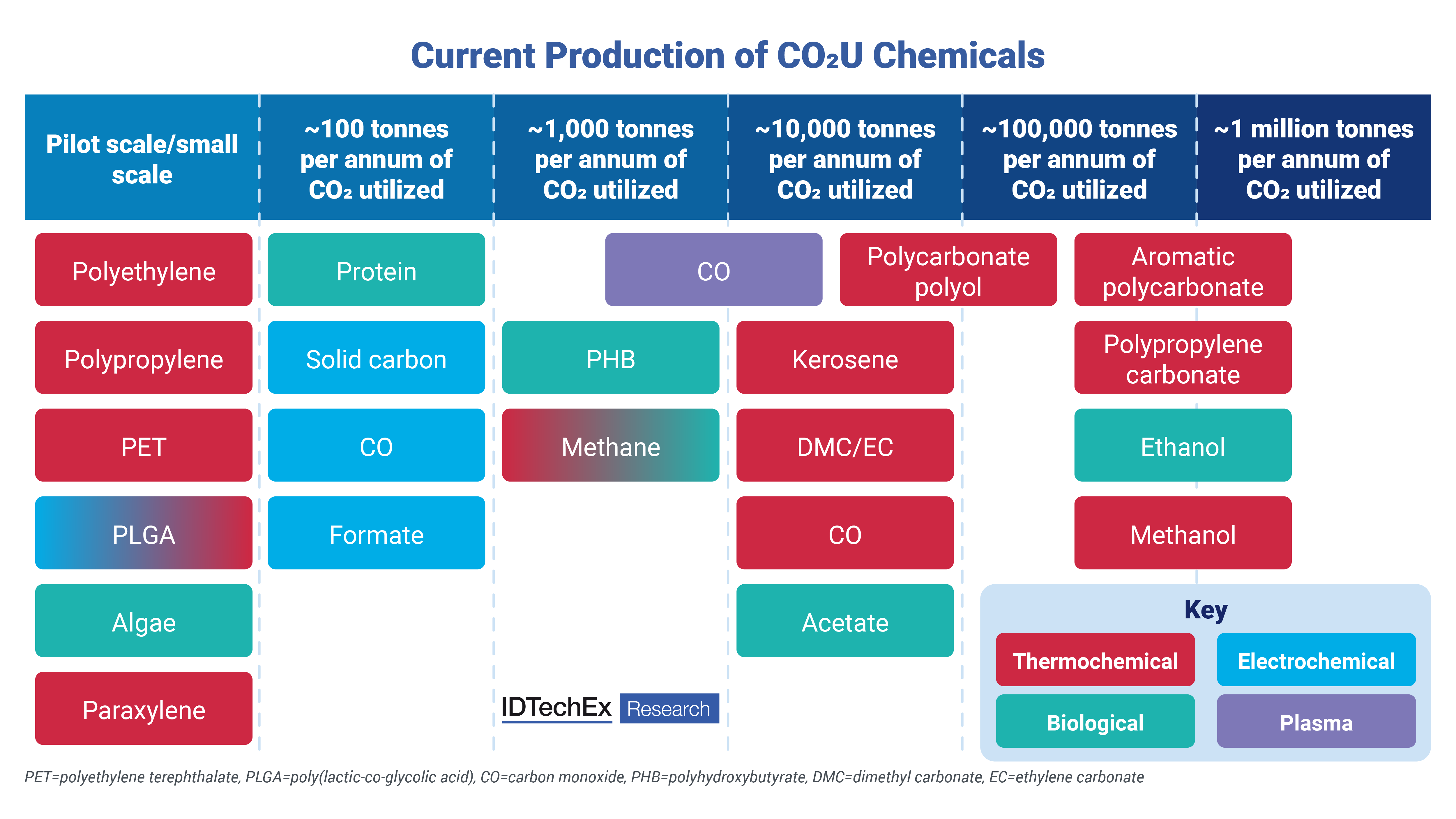
Overview of chemical products that can be made via CO2 utilization. Source: IDTechEx's Carbon Dioxide Utilization 2026-2036: Technologies, Market Forecasts, and Players report
Urea and alcohols
Using CO2 as a feedstock in the chemicals sector is already well-established. Every year, hundreds of millions of tonnes of CO2 are used for urea production. Alcohols such as methanol and ethanol have also progressed to large-scale CO2 utilization in recent years. For example, LanzaTech has developed a biological pathway to CO2-derived ethanol and produces hundreds of thousands of tonnes each year across its facilities. Projects from Carbon Recycling International and Fairway Methanol are producing CO2-derived methanol at a similarly large scale. Significant build-out of e-methanol plants (using captured CO2 and green hydrogen) is expected in China as the Chinese government continues to prioritize strengthening its hydrogen economy.
Crucially, early success stories for CO2U alcohols have utilized waste hydrogen sources (originally from fossil fuels) rather than expensive green hydrogen. This illustrates that in the absence of stricter environmental policy, CO2U products need a strong business case that goes beyond environmental benefits. The intersection of regulatory support for CO2U, performance improvements, and the "green premium" is explored extensively in IDTechEx's "Carbon Dioxide Utilization 2026-2036: Technologies, Market Forecasts, and Players" report.
Polycarbonates and polyols
Profitable CO2U outside of carbon pricing has been demonstrated by Asahi Kasei's process for aromatic polycarbonate production, commercialized in the early 2000s. This improved economics by replacing the phosgene starting material with captured carbon dioxide. Partial utilization of carbon dioxide - which maintains strong carbon-oxygen bonds and does not require green hydrogen - has also been commercialized as a pathway to polypropylene carbonate (PPC) and polycarbonate polyols (polyurethane precursor). The key selling point is the improved performance provided by polycarbonate linkages alongside environmental benefits. Econic Technologies is a player that has developed a catalyst for producing polycarbonate polyols from CO2 and epoxides, and already has several licensees worldwide. This technology allows property finetuning of its polyols.
Polypropylene (PP) and polyethylene (PE)
But what about other plastics, such as polyethylene (the most commonly produced plastic in the world) or polypropylene? Conventional polyethylene is often produced by the steam cracking of naphtha. Intriguingly, this naphtha could be substituted with a CO2-derived e-naphtha byproduct from e-fuel production. The production of e-fuels is expected to scale-up in the EU under mandates such as ReFuelEU, and the Fischer-Tropsch pathway to CO2-derived jet fuel also creates useful byproduct fractions that can be monetized (such as e-naphtha and e-diesel). Infinium, one of the leading e-kerosene players globally, has already supplied CO2-derived polypropylene resin to Volkswagen. Additionally, there are several other CO2U routes being developed for PE and PP, involving intermediates discussed above such as methanol and ethanol.
Alternatives synthesis pathways - Electrochemistry and biological conversion
Most of the above examples involve traditional thermochemistry - where heat drives chemical reactions. However, there is also interest in more exotic synthesis routes, with examples including plasma technologies, electrochemistry, and microbial conversion. Players developing these innovations are pursuing reactions in ambient conditions and ultimately seeking to unlock lower cost synthesis.
A diverse range of carbon-containing products are possible via low-temperature electrolysis of CO2. Popular target molecules within the start-up space include CO(/syngas), methanol, ethylene, and formic acid. Some companies are targeting the e-fuel market as an alternative to the reverse water gas shift pathway, with a company named Twelve currently building a demonstration plant for this purpose. Solid oxide electrolyzers players are also looking towards the e-fuel space via high temperature electrolysis, with co-electrolysis of water and CO2 possible using this technology.
Both thermochemical and electrochemical pathways require relatively high purity CO2, meaning that captured carbon dioxide needs extensive pre-treatment. One advantage of biological pathways is a high tolerance for flue gas impurities. Acetogenic bacteria is often the microbe of choice for CO2U players as genetic tools for these are well-studied. The key technical challenge for scaling CO2U bioreactors is typically limited gas-liquid mass transfer.
Outlook
With many chemicals already being profitably produced via CO2 utilization, and new target molecules and novel synthesis pathways being developed, the decarbonization potential for CO2 utilization within the chemicals sector is vast. According to IDTechEx's "Carbon Dioxide Utilization 2026-2036: Technologies, Market Forecasts, and Players" report, key considerations include regulatory landscape, economics, performance improvements, environmental benefits, and business models.
For more information on this report, including downloadable sample pages, please visit www.IDTechEx.com/CO2U, or for the full portfolio of decarbonization-related research available from IDTechEx, see www.IDTechEx.com/Research/Decarbonization.
